
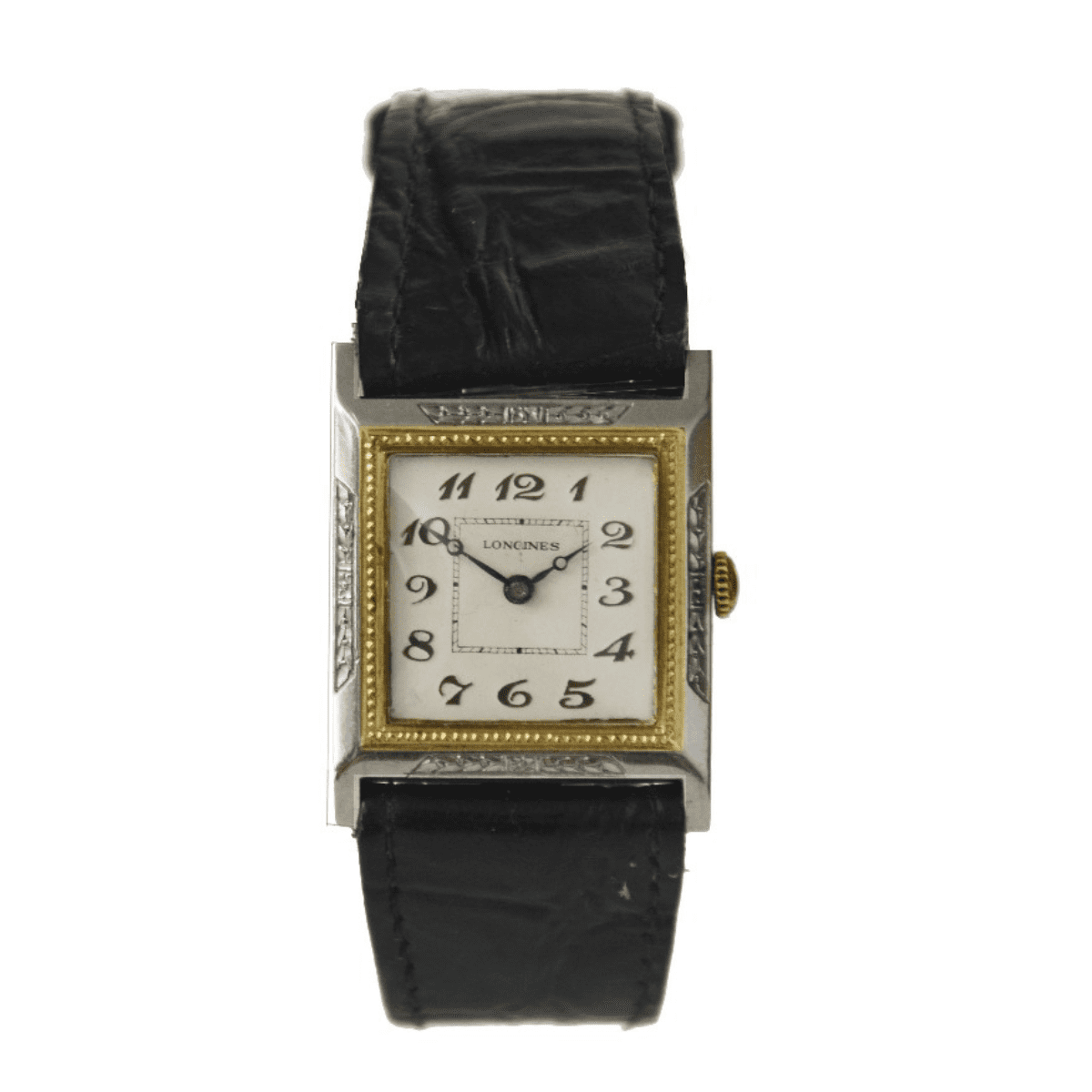

- Brand: Longines
- Country of manufacture: Switzerland
- Production period: 1920s
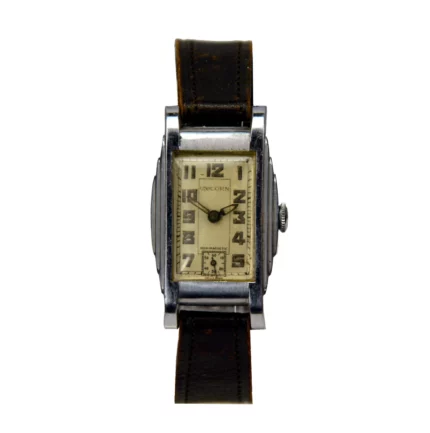
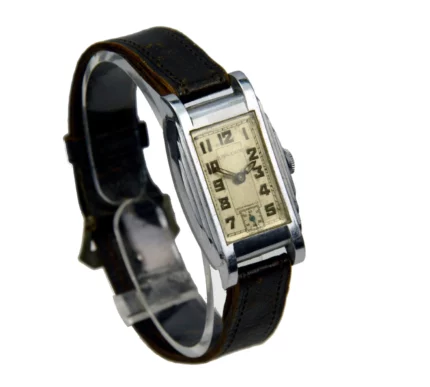
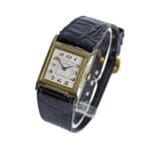
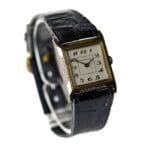
- Style: Art Deco / Tank
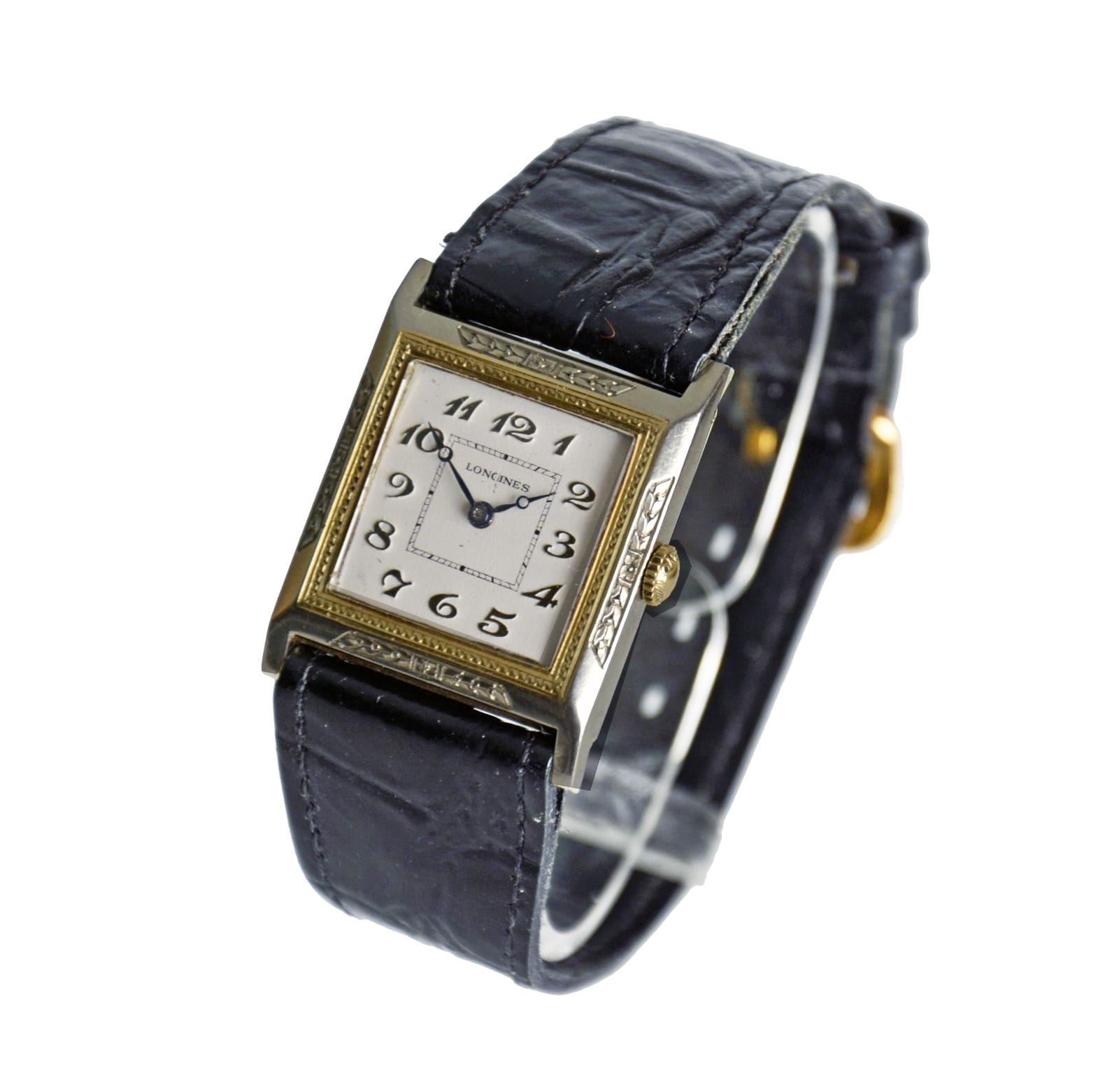
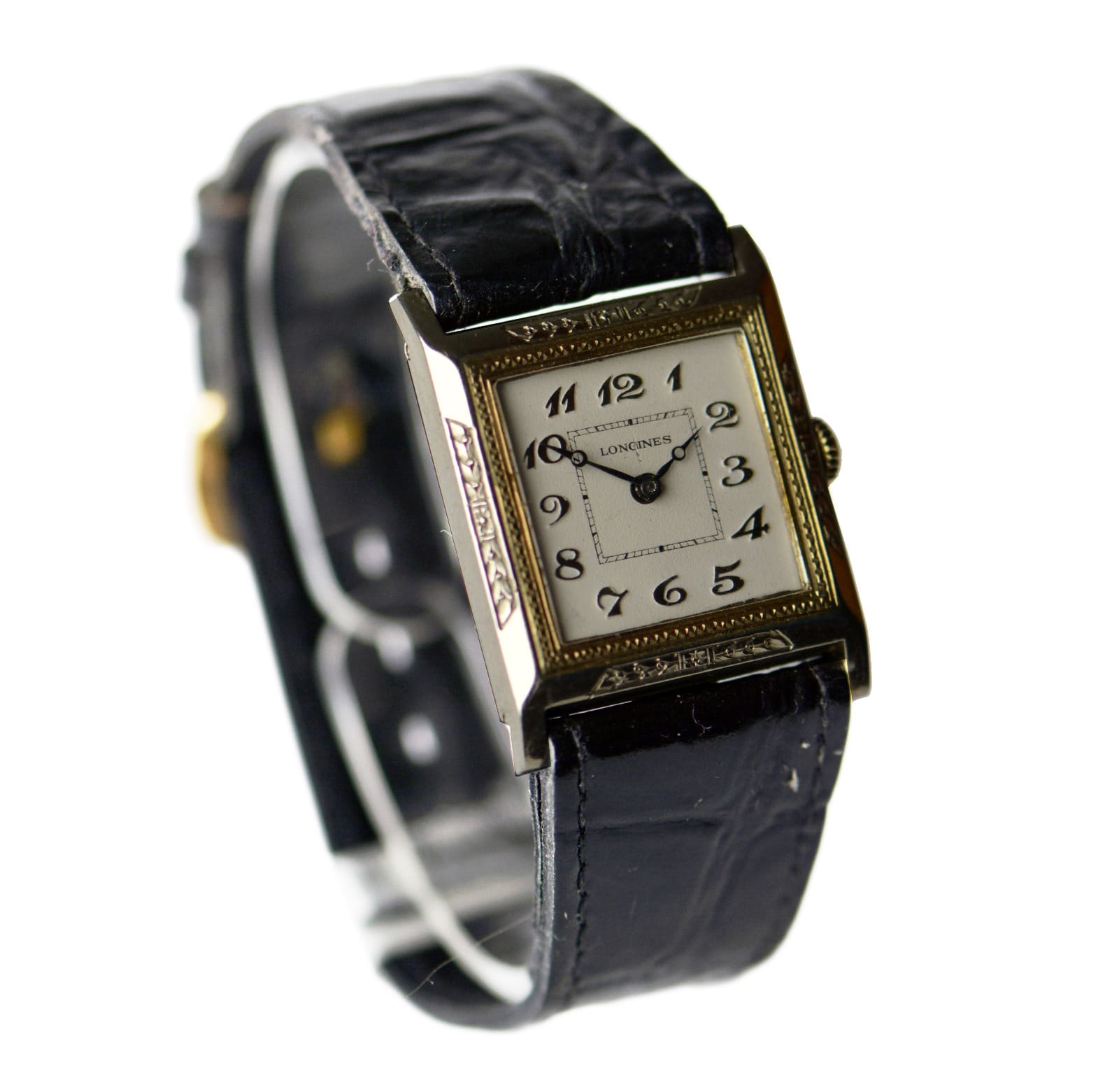
- Case: 14K two-tone white and yellow gold
- Hallmarks: Fully hallmarked
- Case decoration: Hand-engraved bezels / panels
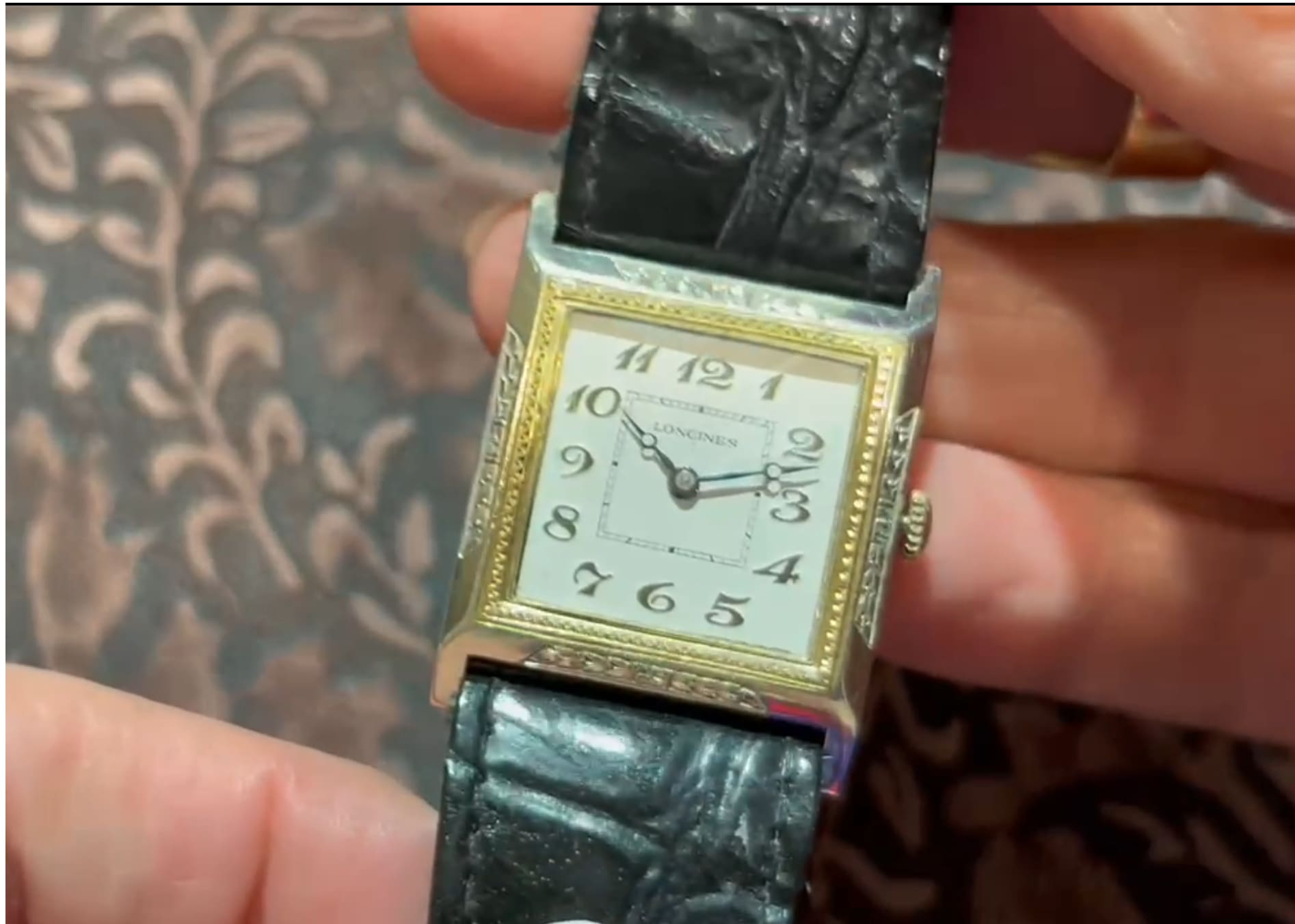
- Dial: Original, raised gold numerals, sub-seconds
- Hands: Blued Breguet-style hands
- Movement: Longines calibre 10.86N, 16 jewels
- Winding: Manual
- Quality: Top, jeweled through to centre wheel
- Crown: Solid yellow gold, signed Longines
- Width: 25 mm excluding winding crown / circa 1"
- Length: 32 mm lug to lug / circa 1¼"
- Condition: Excellent
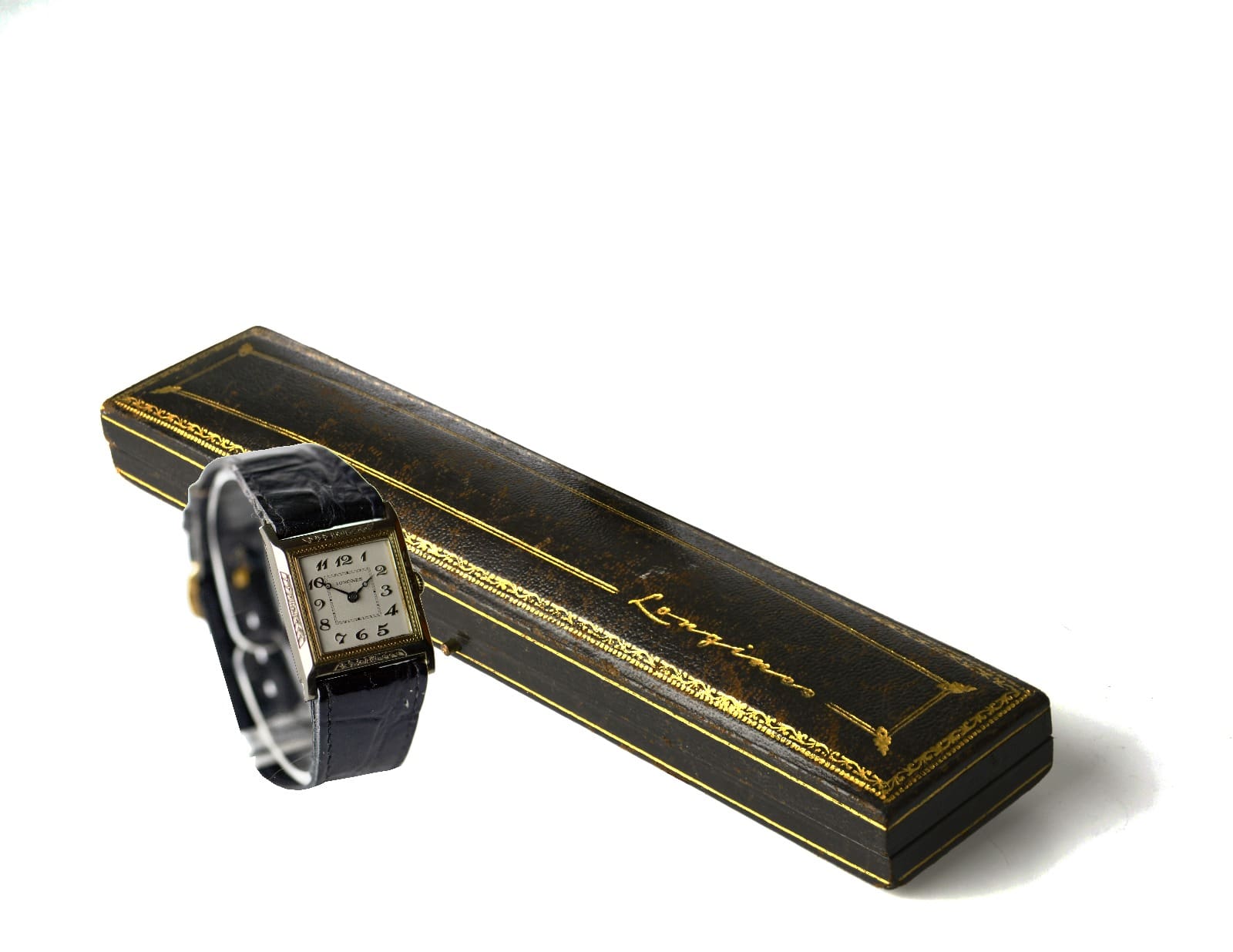
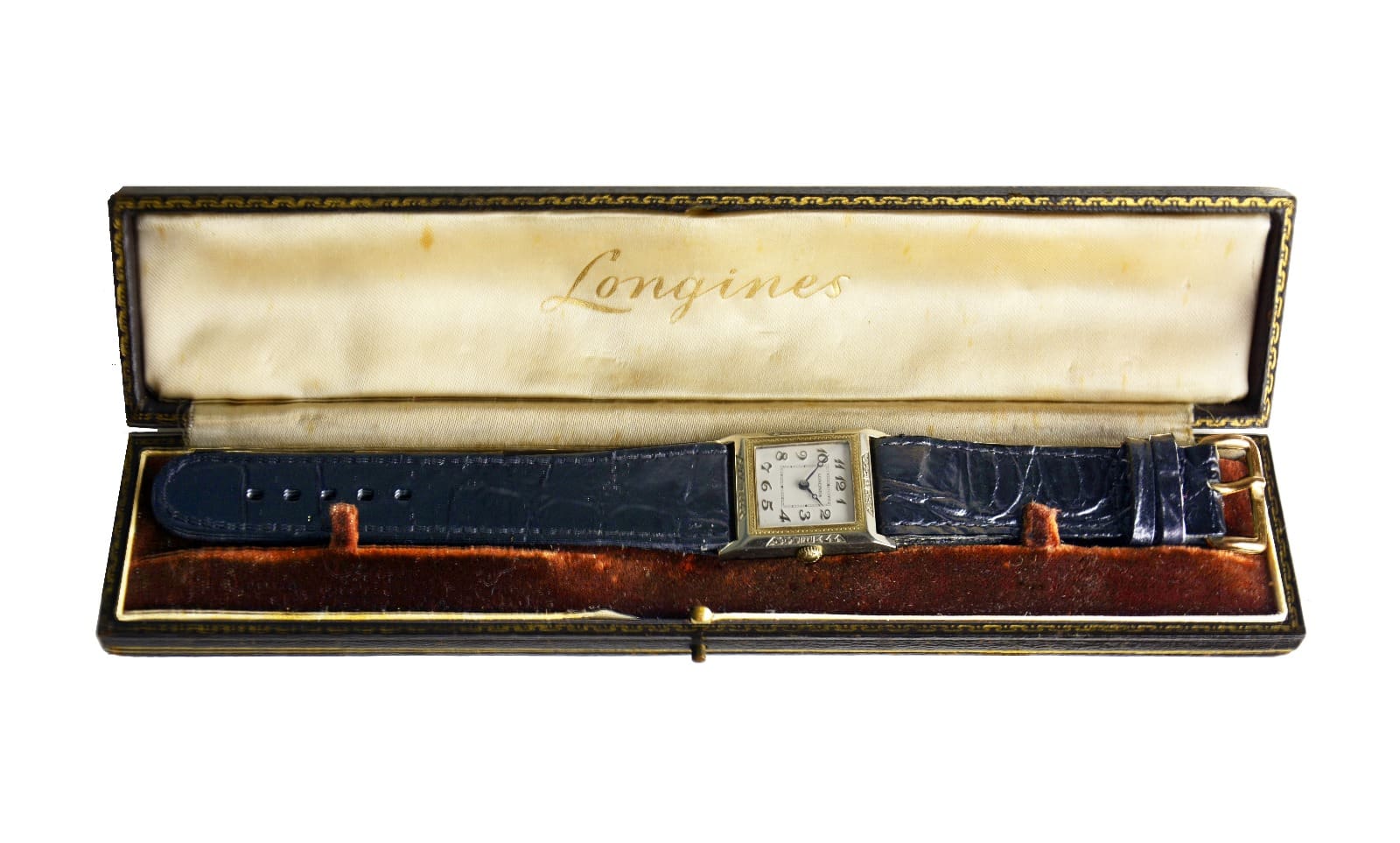
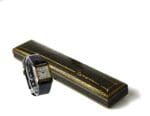
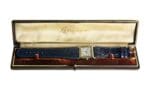
- Included: Original Longines presentation box
Step into the elegance of the Roaring Twenties with this rare and beautifully preserved Longines Art Deco wristwatch, complete with its original presentation box.
Crafted from substantial solid 14K white and yellow gold, this striking watch belongs to an important period when Longines was helping redefine the wristwatch for the modern age. Moving decisively beyond the military-inspired trench watches that had dominated the years surrounding the First World War, the company embraced sophisticated new shapes, materials and decorative treatments perfectly suited to the emerging Art Deco aesthetic.
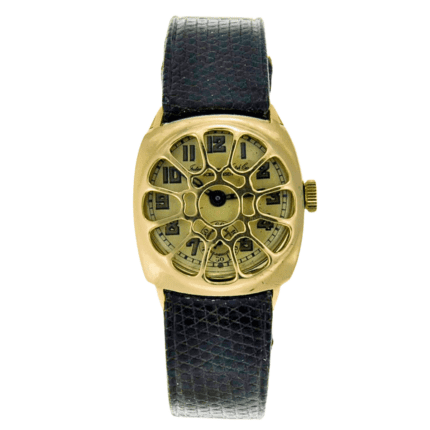
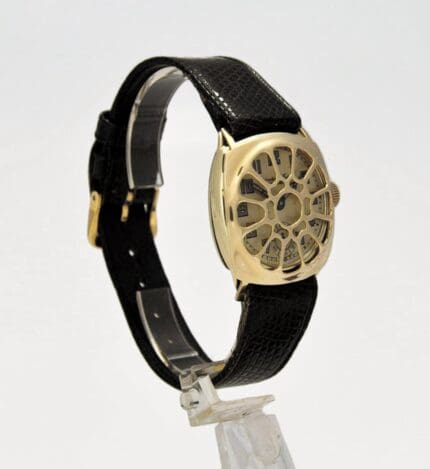
The result here is a wonderfully architectural design. Its rectangular Tank-style case combines contrasting white- and yellow-gold surfaces with finely hand-engraved decoration to the bezel and front panels, creating an effect that is luxurious without becoming ostentatious.
More than a century later, the proportions and geometry remain remarkably contemporary.
The beautifully balanced original dial is distinguished by raised golden Arabic numerals, a subsidiary seconds register and elegant blued Breguet-style hands.
The contrast between the warm applied numerals, deep blue hands and surrounding two-tone gold case gives the watch exceptional visual presence despite its refined dimensions.
At 25 mm wide by 32 mm long, the watch reflects the elegant proportions of its period while its substantial solid-gold construction gives it a surprisingly strong presence on the wrist.
Inside is Longines’ finely engineered calibre 10.86N manual-winding movement.
This high-grade 16-jewel movement is jeweled through the centre wheel and fully signed Longines, reflecting the attention to precision and quality for which the Saint-Imier manufacturer had already become internationally celebrated.
The solid yellow-gold winding crown is likewise signed Longines.
Together, the finely finished movement and richly detailed precious-metal case demonstrate that this was conceived not merely as a practical wristwatch, but as a sophisticated luxury object in which mechanics, craftsmanship and design were given equal importance.
This rare Longines Art Deco wristwatch remains in excellent vintage condition.
The solid two-tone gold case is beautifully preserved, retaining its crisp form and delicate hand-engraved decoration. The original dial, raised numerals and blued hands remain exceptionally attractive.
The watch has been fully serviced by a Master Swiss watchmaker and is functioning properly.
It is accompanied by its original Longines presentation box—an increasingly uncommon addition that makes this an especially complete and desirable surviving example.
The history of Longines dates to 1832, when Auguste Agassiz and two partners established a watchmaking enterprise in Saint-Imier, Switzerland. By 1838, after Agassiz assumed control, the firm became known as Agassiz & Compagnie and ultimately evolved into the Longines Watch Company.
Like many Swiss manufacturers of the period, its earliest production followed the traditional établissage system: individual craftsmen working in small workshops produced specialized components that were progressively assembled into complete watches.
A decisive transformation came when Auguste Agassiz transferred control of the company to his nephew Ernest Francillon in 1862.
Recognizing the limitations of decentralized production, Francillon sought to bring the entire manufacturing process under one roof. In 1867 he established a modern factory in an area of Saint-Imier known as Les Longines—“the long meadows”—from which the company subsequently took its name.
Centralized production allowed Longines to exercise far greater control over quality, precision and technical development. The company also became an early pioneer in protecting its identity, registering its celebrated Winged Hourglass trademark in 1889. The emblem remains in use today.
Longines began producing chronographs in the nineteenth century and subsequently established an exceptional reputation for precision sports timing. In 1912 it introduced an automatic timing system for sporting events, beginning an association with competitive timekeeping that would continue for generations.
During the early twentieth century, Longines also became a major force in the evolution of the wristwatch. The company embraced increasingly sophisticated case shapes, decorative treatments and precious-metal combinations that reflected the rapidly changing artistic language of the period.
Its technical expertise later extended to aviation and navigation. Longines became closely associated with pioneering aviators and developed such celebrated instruments as the Weems Second-Setting Watch and the Lindbergh Hour Angle Watch, introduced in collaboration with Charles Lindbergh in 1931.
The post-war period brought further important collections, including the Conquest in 1954, while Longines continued its involvement in precision sports timing and advanced electronic timekeeping.
Today, Longines remains one of Switzerland’s most distinguished historic watch manufacturers, internationally recognized for combining technical accomplishment with restrained elegance.
Created during the extraordinary flowering of Art Deco in the 1920s, the present two-tone solid-gold wristwatch belongs to one of the most visually adventurous periods in that history. Its hand-engraved case, beautifully preserved original dial, high-grade calibre 10.86N movement and original presentation box combine to make it both an exceptional collector’s watch and a remarkably wearable survivor of the Roaring Twenties.