




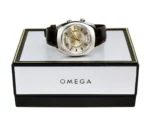
- Brand: Omega
- Collection: Seamaster
- Model: Memomatic
- Reference: 166.072
- Year: 1970
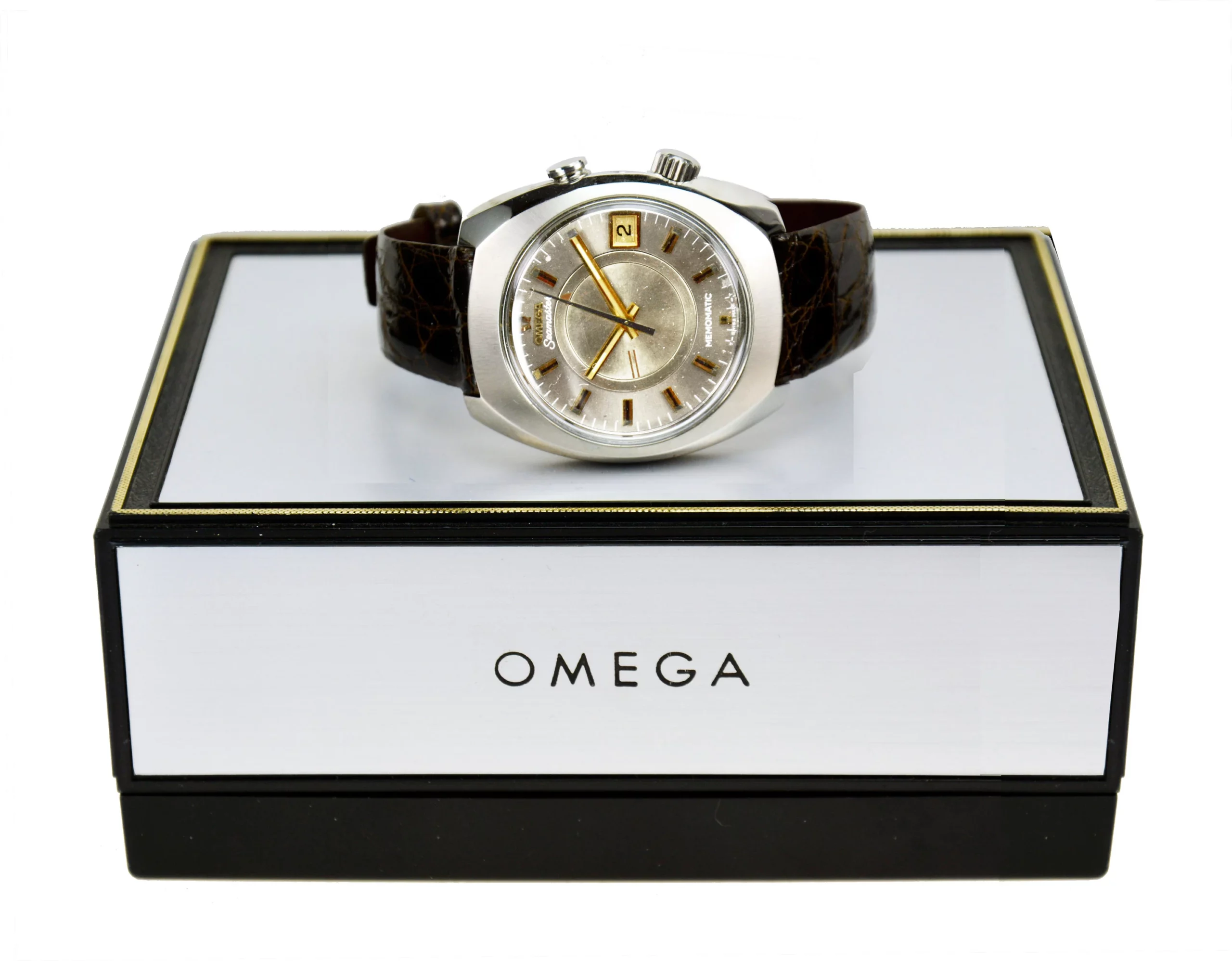
- Case: Stainless steel, fully signed Omega
- Width: 39 mm excluding crowns
- Length: 44 mm lug to lug
- Movement: Omega automatic calibre 980
- Alarm: Independent hour and minute
- Frequency: 21,600 vibrations per hour
- Bracelet: New old stock vintage bracelet
- Condition: Near Mint to Mint
- Included: Original Omega presentation box
This remarkable 1970 Omega Seamaster Memomatic is distinguished by its superb case design, strikingly modern dial and technically groundbreaking automatic alarm movement.
More than half a century after its introduction, its bold yet balanced appearance remains remarkably contemporary. The substantial stainless-steel case, contrasting dial indications and rotating alarm-setting discs create a watch that is immediately recognizable, yet exceptionally wearable.
The Memomatic was the first mechanical alarm wristwatch to permit the alarm to be set precisely to a particular hour and minute. Earlier alarm watches allowed only approximate setting, making Omega’s system a major practical and technical advance.
The two inner discs are used to select the desired alarm time: one indicates the hour, while the second permits precise minute-by-minute adjustment. This unusually sophisticated arrangement gives the dial its distinctive appearance while serving an entirely functional purpose.
At the heart of the Memomatic is Omega’s extraordinary automatic calibre 980.
Unlike other vintage alarm-watch movements of the period, the calibre 980 uses a single mainspring barrel to power both the timekeeping mechanism and the alarm. The automatic winding system therefore simultaneously supplies energy to both functions.
The technical brilliance of this construction should not be underestimated. Omega registered a patent for the design in 1968, with the patent published in May 1971, at precisely the time when the emerging quartz revolution was beginning to transform Swiss watchmaking.
The movement was designed by Raoul-Henri Erard under the supervision of Albert Piguet and manufactured at Omega’s Lemania facility, the source of the company’s chronograph and complicated movements.
It operates at 21,600 vibrations per hour and provides a power reserve of approximately 48 hours, including sufficient energy for one alarm activation.
Its high-grade functional finishing includes Omega’s characteristic copper-coloured electroplated coating, continuing a long-established tradition found on the company’s finest movements.
Fewer than 35,000 Memomatic watches were produced across the four models in the series. Of these, fewer than 6,000 examples are believed to have been made in this early configuration.
Even when new, the Memomatic was therefore produced in comparatively limited numbers. Surviving examples in exceptional condition, particularly accompanied by an original Omega presentation box, are increasingly difficult to find.
This Omega Seamaster Memomatic is preserved in Near Mint to Mint condition.
The watch has been completely serviced by a Master Swiss watchmaker and is functioning properly, including its automatic winding, timekeeping and alarm systems.
The stainless-steel case remains exceptionally well preserved, with its original form and detailing clearly defined. The remarkable dial is equally beautiful, retaining the distinctive appearance that makes the Memomatic one of the most recognizable Omega designs of its era.
The watch is fitted with a new old stock vintage bracelet and is accompanied by its original Omega presentation box.
The Omega Watch Company was founded by Louis Brandt in La Chaux-de-Fonds, Switzerland, in 1848. The young firm initially assembled precision key-wound pocket watches using components supplied by specialist craftsmen throughout the region.
Following Louis Brandt’s death in 1879, his sons Louis-Paul and César assumed control of the business and transformed it into one of Switzerland’s leading industrial watch manufacturers.
When both brothers died in 1903, they left one of the country’s largest watch companies, employing approximately 800 people and producing some 240,000 watches annually. Control passed to the next generation of the Brandt family, led by Paul-Emile Brandt.
The difficult economic conditions following the First World War encouraged closer cooperation between Omega and Tissot. This relationship ultimately led to the establishment of the SSIH group in 1930.
By the 1970s, SSIH had become Switzerland’s largest producer of finished watches. The severe monetary crisis and recession that affected the Swiss watch industry between 1975 and 1980 subsequently led to a major restructuring.
In 1985, the reorganized holding company became SMH, Société Suisse de Microélectronique et d’Horlogerie. Renamed the Swatch Group in 1998, it developed into one of the world’s foremost watchmaking groups.
Throughout these transformations, Omega has remained one of Switzerland’s most prestigious and technically accomplished watch manufacturers.