




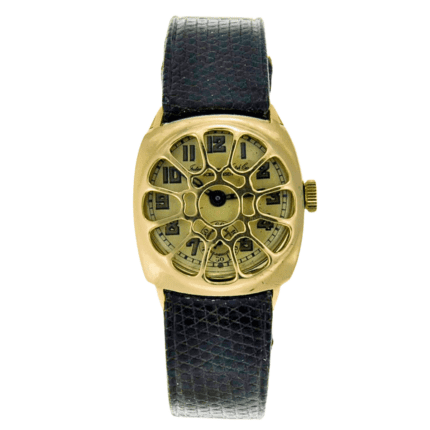
- Model: Submarine
- Origin: London, England
- Year: 1931
- Type: Early water-resistant wristwatch
- Case: Solid 9K gold
- Bezel: Fluted
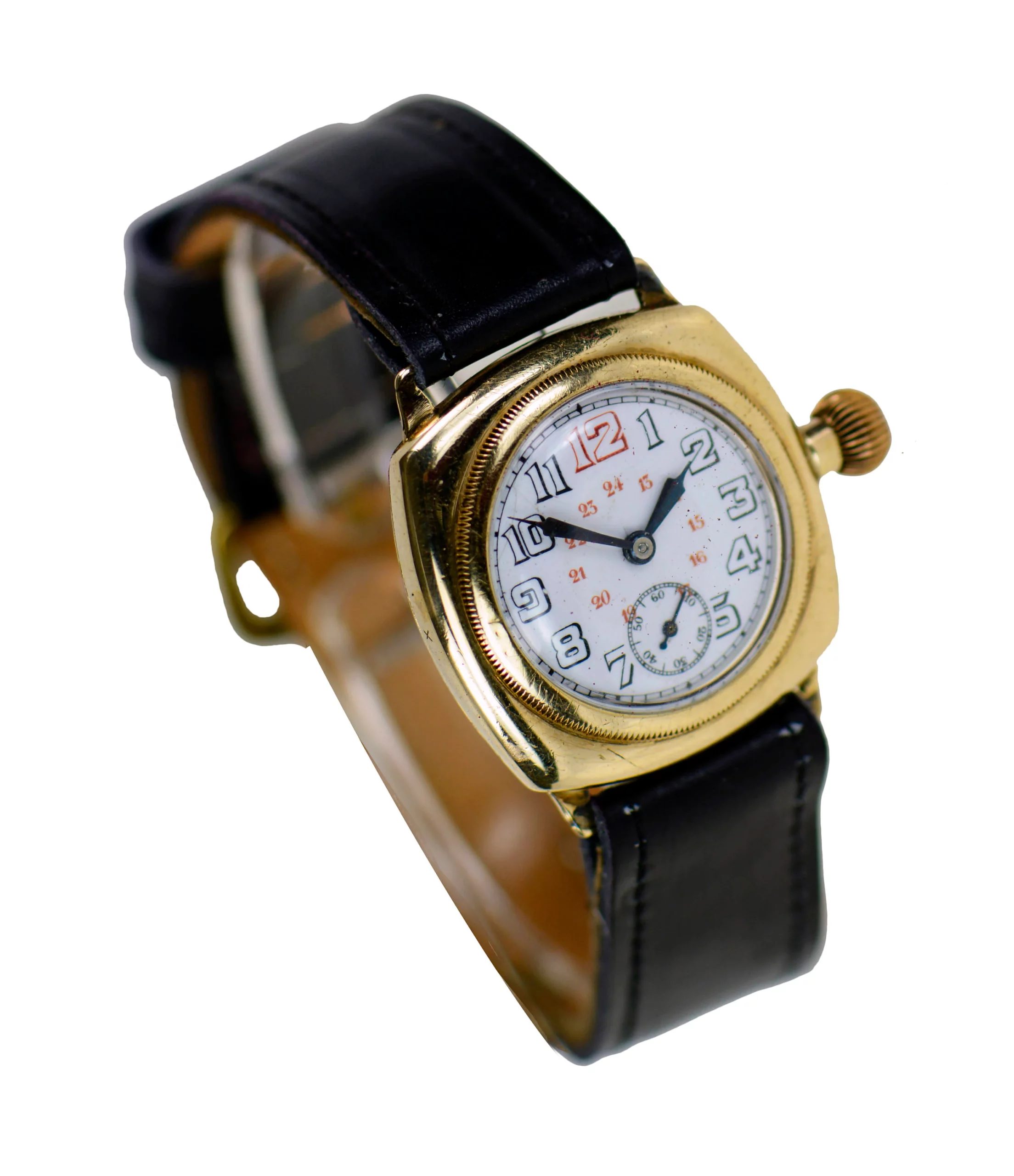
- Dial: Original porcelain enamel, 24-hour
- Numerals: Black 1–11 with red 12–24 indications
- Case width: 30 mm excluding winding crown
- Length: 40 mm lug to lug
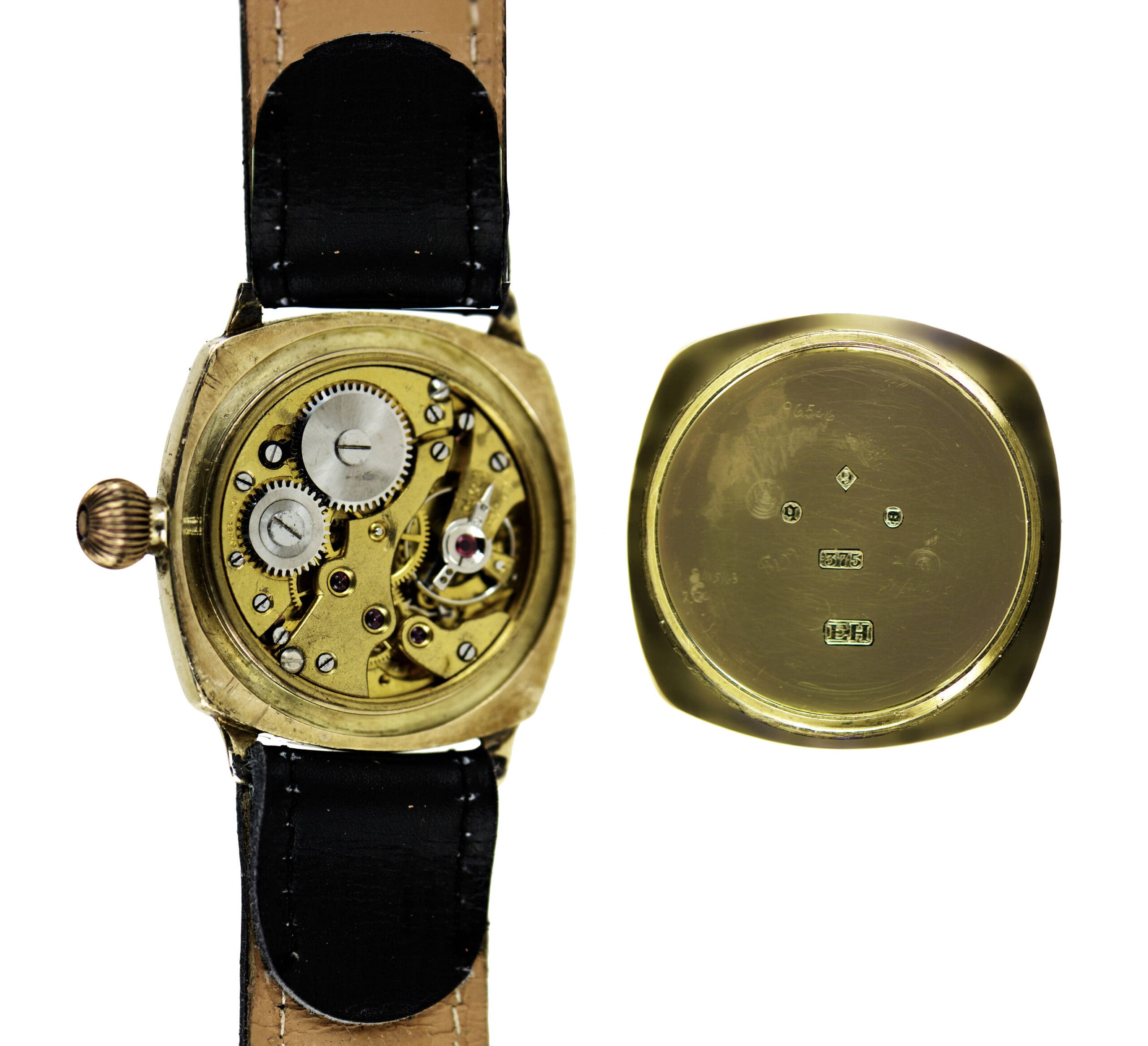
- Hallmarks: London, 375 / 9K gold, dated 1931
- Goldsmith’s mark: EH for E.G. Harrup
- Strap: NOS hand-stitched period leather
- Condition: Excellent
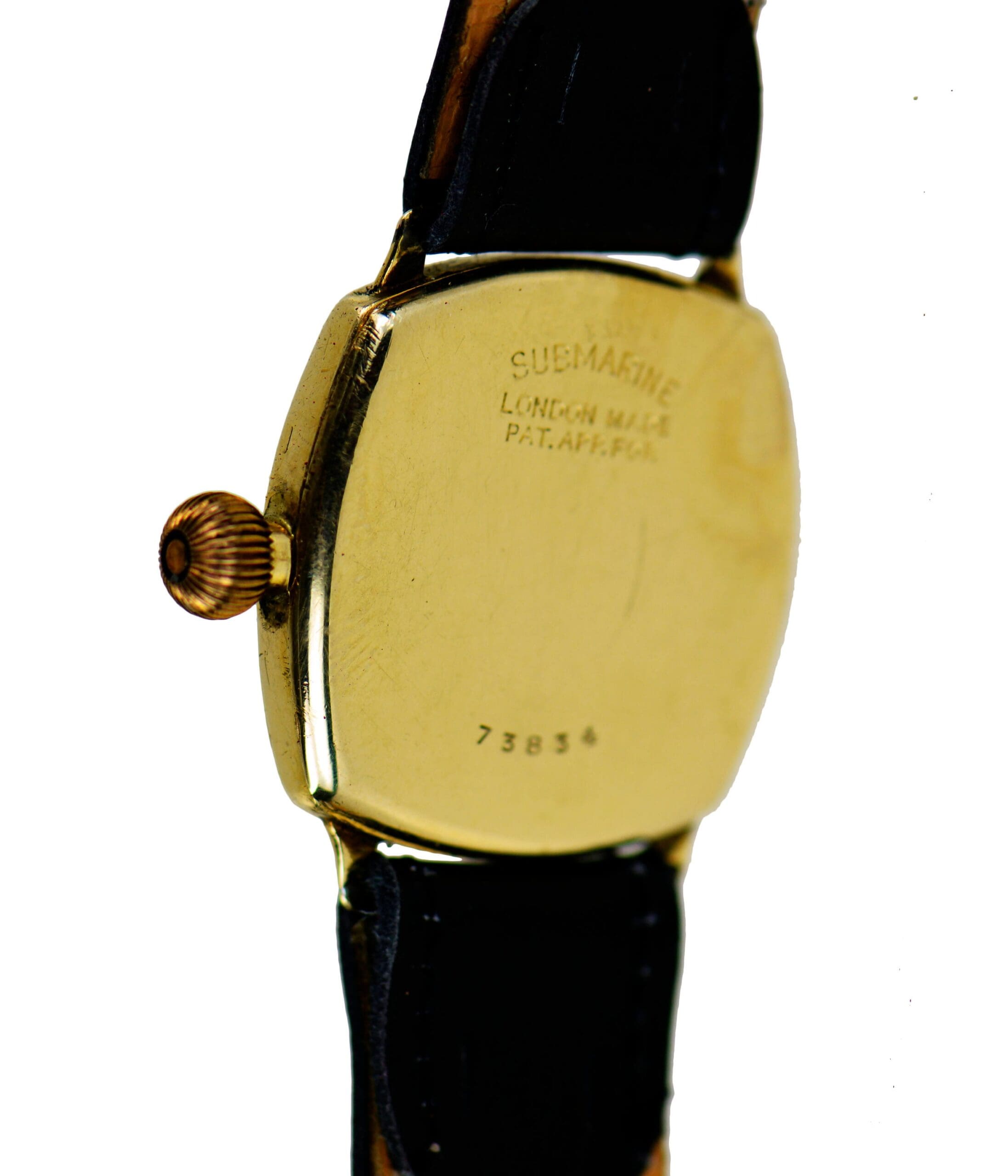
Case signed SUBMARINE, LONDON MADE, PAT. APP. FOR
Grandfather of the waterproof wristwatch and godfather of the now-iconic Rolex Oyster Submariner, the Submarine Commanders’ Wristwatch occupies a fascinating and little-known place in the development of the modern sports watch.
Its story began during the First World War, when two British submarine commanders approached the distinguished Edinburgh jewellers, watchmakers and Royal Goldsmiths Brook & Son with an unusual request: to construct a wristwatch specifically suited to the extraordinary conditions aboard a submarine.
The requirements were formidable.
Even when a submarine was surfaced, its deck was frequently awash, so the watch needed to be effectively water-tight. It also needed to resist magnetism, since submerged submarines relied upon powerful electrical equipment operating within an extremely confined space. Finally, its regulating components had to remain stable despite significant changes in temperature.
Brook & Son accepted the challenge.
Brook & Son correctly recognized the principal weakness of a water-resistant watchcase: the opening through which the winding and setting stem passes.
Their solution incorporated a gland seal around the stem, permitting the crown to be operated while maintaining the integrity of the case.
This was an important early approach to a problem that would preoccupy watchmakers for decades. Rolex founder Hans Wilsdorf would subsequently pursue his own solution, culminating in the screw-down crown used for the Rolex Oyster following his acquisition of the Perregaux and Perret patent rights in 1926.
For the movement, Brook & Son turned to the important Swiss manufacturer Tavannes, renowned both for its high-quality movements and its technical innovations.
Tavannes developed special iron-nickel alloy components for the Submarine watch, chosen both for their resistance to magnetism and for their exceptionally low expansion and contraction under changing temperatures.
The resulting watch was sufficiently innovative to become the subject of a technical article in The Horological Journal in December 1917.
THE SUBMARINE EVOLVES Development of the Submarine Wristwatch continued well beyond the First World War.
In 1931, London jeweller and inventor E.G. Harrup—known also for his work on the expanding watch bracelet—further developed the Submarine case in collaboration with F. Wachter of New York.
Their improvements, covered by patents N° 358370 and N° 362229, included changes to the bezel and the introduction of a water-tight snap-back case.
The watch offered here dates precisely from this important period.
Its solid 9K gold case bears London hallmarks for 1931 together with the maker’s mark EH for E.G. Harrup, and is expressly signed:
SUBMARINE LONDON MADE PAT. APP. FOR Its fluted bezel, case proportions and overall appearance also bear a striking visual resemblance to the earliest generation of Rolex Oyster watches.
Hans Wilsdorf’s pursuit of a genuinely practical water-resistant wristwatch extended over many years.
Beginning in the 1910s, Rolex experimented with a succession of water-resistant case constructions, including those associated with Dennison, Borgel and Baumgartner, eventually culminating in the launch of the Rolex Oyster case in 1926.
At the time, both Rolex and the Submarine Wristwatch were British watch enterprises, and the development of such a technically unusual competing water-tight wristwatch would hardly have escaped Wilsdorf’s attention.
Most intriguingly, on March 31, 1922, Rolex registered the name:
THE SUBMARINE Copyright N° 51632.
Yet almost a decade later, Harrup was still producing and commercializing watches bearing the Submarine name.
The relationship is particularly fascinating in retrospect. Decades later, Rolex would adopt the closely related name SUBMARINER for what became one of the most celebrated sports watches ever produced.
Despite its remarkable technical and historical importance, the Submarine Wristwatch has remained surprisingly obscure.
A detailed study published in the May/June 2014 issue of the NAWCC Watch & Clock Bulletin drew particular attention to this paradox: these watches had already addressed water resistance, magnetism and temperature compensation during the First World War—nearly a decade before the introduction of the Rolex Oyster.
The Submarine also possessed an important practical advantage. Its sealed winding stem could be operated without first unscrewing a crown, allowing the watch to remain protected while being wound or set and avoiding the vulnerable threaded crown tube used on early screw-down systems.
The author of the NAWCC study ultimately suggested that the watch may simply have lacked the visionary commercial champion that Hans Wilsdorf became for the waterproof wristwatch.
That observation gives the surviving Submarine watches particular historical resonance today.
The present watch is housed in a substantial solid 9K gold case with an elegant fluted bezel.
Its beautiful porcelain-enamel 24-hour dial is especially distinctive, displaying conventional black numerals from 1 through 11 together with contrasting red indications from 12 through 24.
The case measures 30 mm across, excluding the winding crown, and 40 mm from lug to lug—generous and highly wearable dimensions for a wristwatch of its period.
It is fitted with a New Old Stock hand-stitched leather strap manufactured during the same general period as the watch.
This historically important Submarine Wristwatch remains in excellent vintage condition.
The solid-gold case, fluted bezel and original porcelain-enamel dial are beautifully preserved, while the important case signatures and London hallmarks remain clearly defined.
The watch has been fully serviced and tested by our Master Swiss watchmaker and is functioning properly.
The Submarine Wristwatch was originally designed and manufactured as a “water-tight” watch and represents an important early step in the development of the waterproof wristwatch.
However, this example is now almost a century old. It should therefore be regarded today as a valuable vintage timepiece and SHOULD NOT BE IMMERSED IN WATER.