
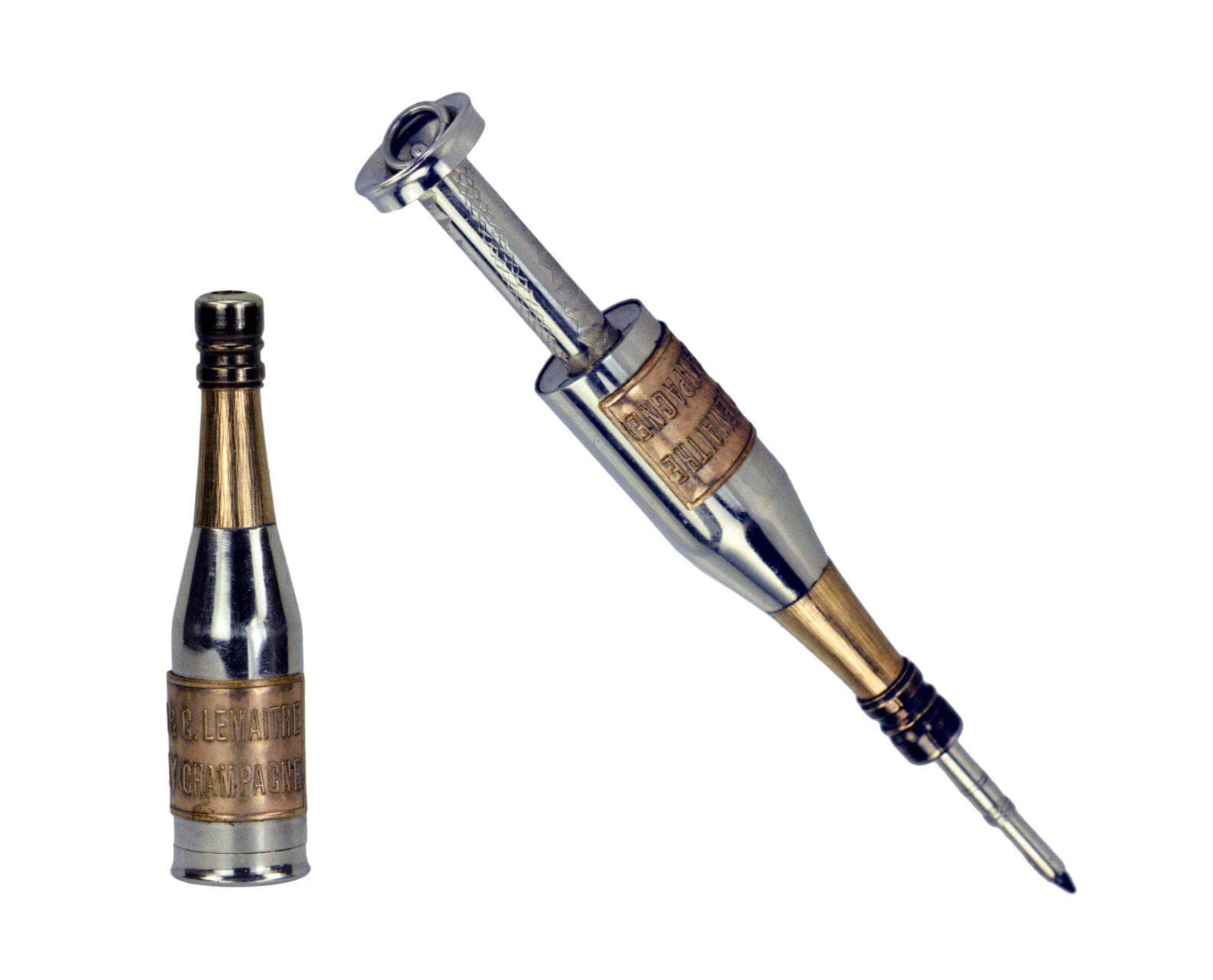

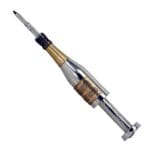

- Type: Victorian “Magic Pencil” / propelling pencil
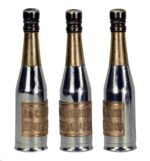
- Form: Miniature Champagne bottle
- Theme: Champagne, Car Racing and Murder
- Period: Circa 1890
- Decoration: Polychrome precious-metal
- Mechanism: Concealed telescopic pencil
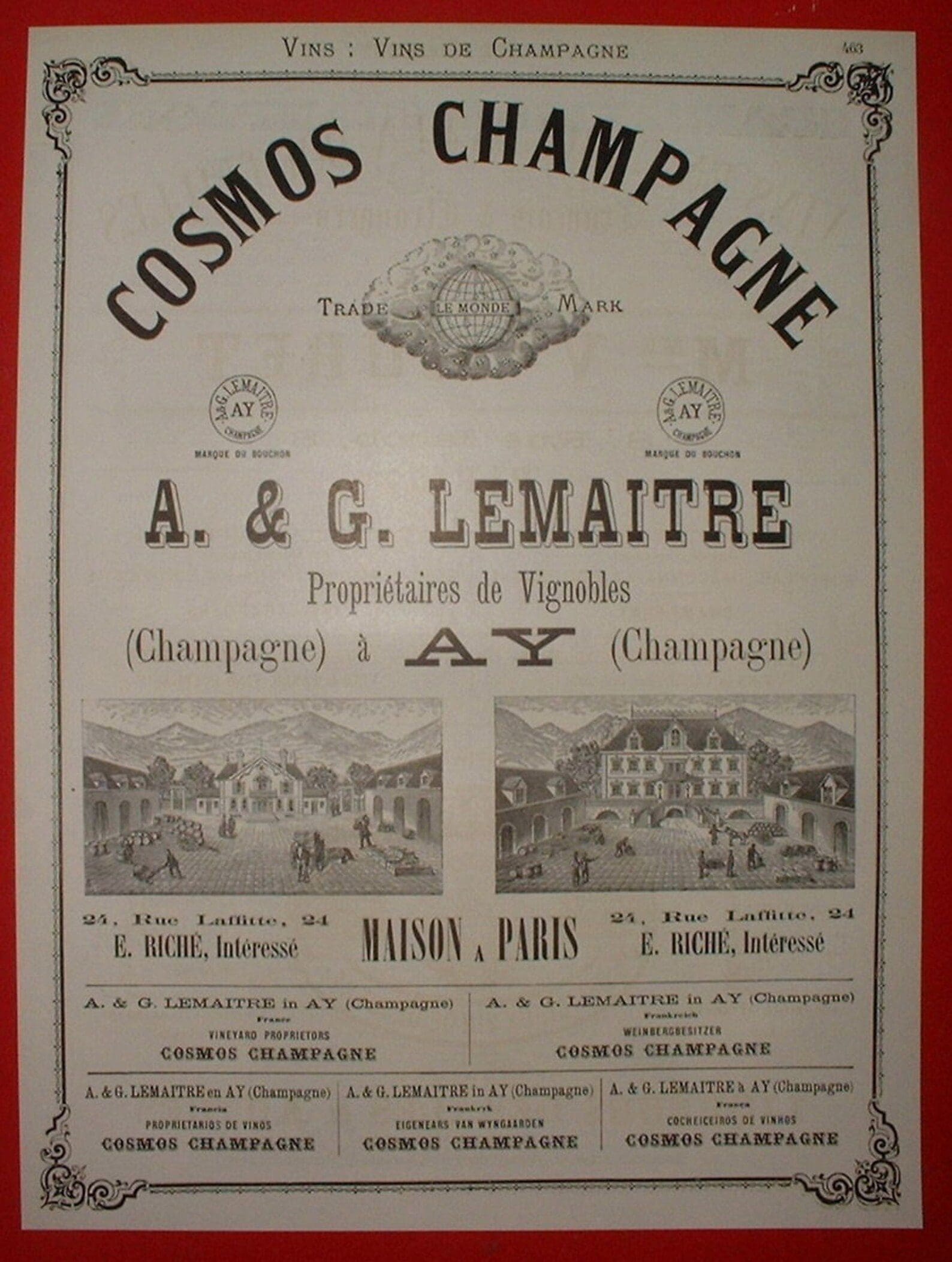
- Champagne house: A. & G. Lemaître, Aÿ, France
- Length extended: 12.5 cm / approximately 4⅞"
- Length retracted: 7 cm / approximately 2¾"
- Condition: Excellent / Near Mint
- Working status: Tested and fully functional
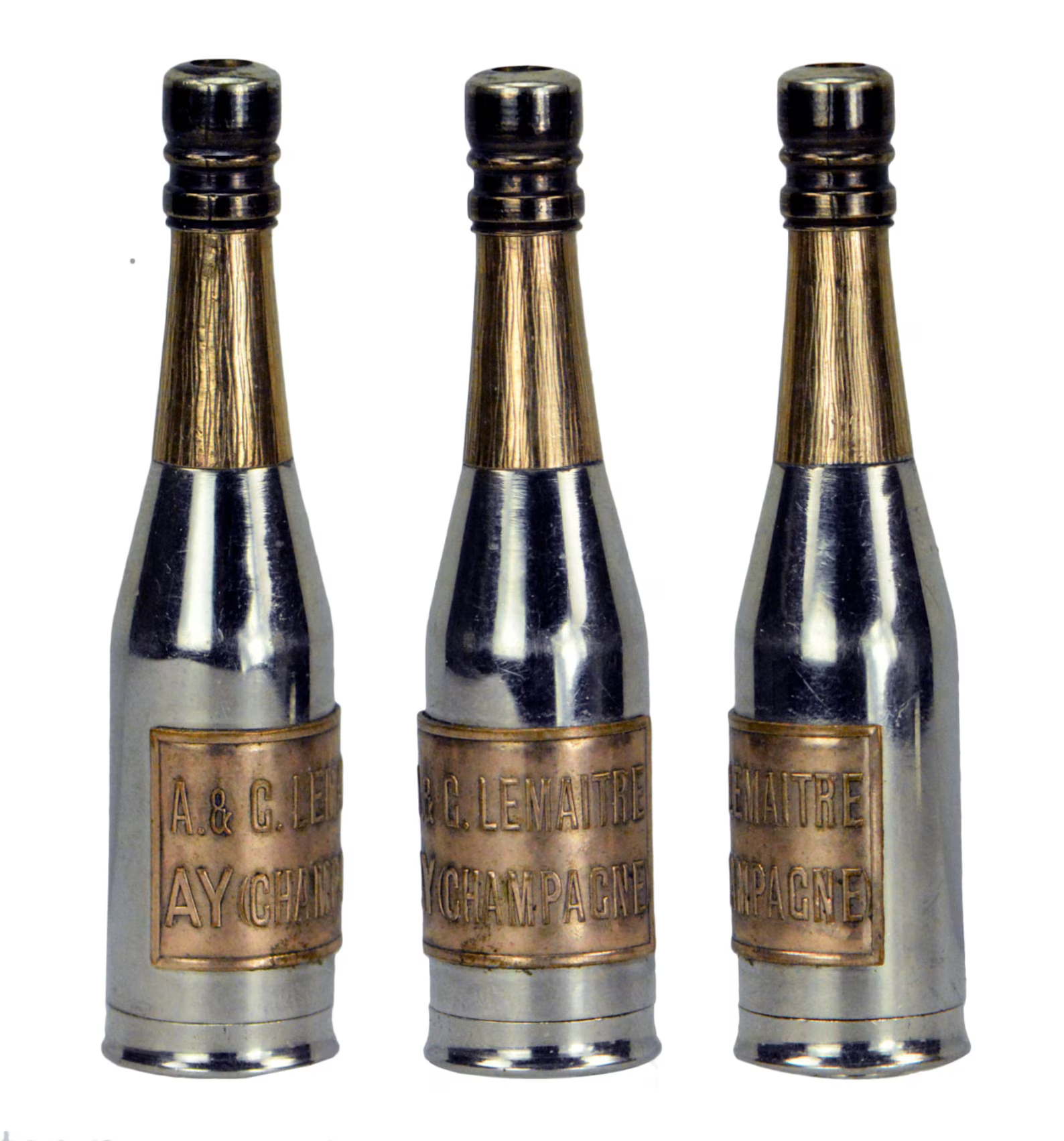
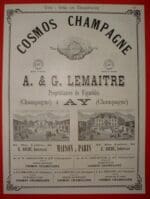
Marked A & G LEMAITRE CHAMPAGNE
All three stories converge in this exceptionally rare Victorian figural “Magic Pencil,” dating from circa 1890 and made in the form of a miniature bottle of A. & G. Lemaître Champagne of Aÿ, France.
The name on that bottle leads directly to Albert Lemaître: Champagne producer, pioneering automobile racer and one of the principal protagonists of the celebrated 1894 Paris–Rouen competition, generally regarded as the world’s first competitive motoring event.
Then, in 1906, Lemaître became notorious for an altogether darker reason: he shot and killed his 28-year-old wife Lucie, attempted suicide, survived—and was subsequently acquitted in a sensational trial in which the killing was treated as a “crime of passion.”
And all of that remarkable history is embodied in an ingenious Victorian writing instrument small enough, when closed, to be worn as a pendant.
At first glance, it appears simply to be a beautifully executed miniature Champagne bottle.
Then comes the magic. Pull gently on its base and the pencil nozzle and upper section telescope outward from inside the bottle, transforming the decorative objet de vertu into a fully functional propelling pencil.
Retract the mechanism and the pencil disappears once again into its Champagne-bottle disguise.
It is precisely this almost theatrical transformation that gave such ingenious Victorian mechanical pencils their evocative name: Now it is an objet de vertu. Abracadabra—it is a writing instrument.
The nineteenth century had a particular fascination with objects that combined craftsmanship, mechanical ingenuity and surprise.
Pencils, vinaigrettes, seals, scent bottles and other miniature implements were transformed into jewellery-like objects sufficiently small and attractive to be suspended from a watch chain or worn as a pendant.
The present pencil belongs squarely to this delightful tradition, but is especially appealing because its disguise is so complete.
When extended, it becomes a surprisingly substantial writing instrument. When retracted, it contracts to little more than half that length and once again assumes the appearance of a miniature Champagne bottle.
Its contrasting polychrome metalwork and minute detailing make it as much an objet de vertu as a writing instrument.
But its ingenious mechanism is only the beginning of its story.
The bottle represented here is not imaginary. It is specifically marked: A & G LEMAITRE CHAMPAGNE
A. & G. Lemaître produced Champagne in Aÿ, near Épernay, in the heart of France’s Champagne region.
Aÿ has for centuries occupied an especially distinguished position in Champagne production. Its vineyards are classified Grand Cru, and the commune remains associated with celebrated Champagne houses including Bollinger and Ayala.
The present pencil therefore represents not merely a generic Champagne bottle, but the product of an actual nineteenth-century Champagne house.
And behind the name Lemaître lies an astonishing story.
Albert Lemaître was born around 1864 in Aÿ, where he worked in partnership with his brother in the Champagne industry.
Yet Champagne was only one chapter of his remarkable life.
At precisely the moment when the motorcar was emerging from experimental curiosity into practical reality, Albert Lemaître became one of the pioneers willing to race one.
In July 1894, journalist Pierre Giffard organised the celebrated Paris–Rouen competition for “horseless carriages,” generally regarded as the world’s first competitive motoring event.
The course covered approximately 126 kilometres from Paris to Rouen.
Albert Lemaître entered in a 3-horsepower Peugeot Type 7 petrol-powered motorcar.
At the luncheon stop in Mantes he was already in first place, having achieved the fastest time among the competitors.
He subsequently completed the second and final 80-kilometre stage and reached Rouen with his three passengers in an overall time of 6 hours, 51 minutes and 30 seconds—approximately thirteen minutes ahead of Auguste Doriot’s Peugeot.
The steam-powered De Dion-Bouton driven by the Comte Jules-Albert de Dion reached Rouen first, but was ineligible for the principal prize because its operation required a separate stoker to tend the boiler.
Lemaître and his Peugeot thus became protagonists in one of the foundational events in the history of the motorcar.
He continued competing during the pioneering years of automobile racing, achieving first-, second- and third-place finishes in a number of important early competitions.
From the Champagne-producing village of Aÿ, Albert Lemaître had become one of the personalities of Europe’s extraordinary new mechanical age.
But Lemaître’s name would later become famous for a profoundly different reason.
Around 1901 Albert married Lucie Dumény. Before their marriage, Lucie had been engaged to another man, but that relationship had been broken off for family reasons.
After approximately four years of marriage, Lucie rekindled her relationship with her former fiancé.
In February 1906 she filed for divorce from Albert and left the marital residence.
Then, on May 7, 1906, the story took a horrifying turn.
Albert Lemaître confronted Lucie and shot her twice, killing her. She was twenty-eight years old and had no children.
Lemaître then turned the weapon upon himself and shot himself in the head. He survived. Upon learning of Lucie’s death, her lover also shot himself.
Albert Lemaître was subsequently brought to trial in September 1906. And, astonishingly from a modern perspective, he was acquitted.
The jury accepted what contemporary society termed a “crime of passion”—a verdict that today provides a striking and disturbing glimpse into the social and judicial attitudes of the Belle Époque.
Thus the man whose name had been associated with Champagne, technological optimism and the exhilarating birth of motorcar racing became the central figure in an extraordinary story of passion, murder, attempted suicide and acquittal.
It is difficult to imagine all of that history embodied in an object measuring barely 7 centimetres when closed. Yet that is precisely what makes this piece so compelling.
It belongs to the world of Victorian mechanical ingenuity, represents a Champagne house in one of France’s most celebrated wine-producing villages, and bears the name of a man who drove a primitive 3-horsepower Peugeot in one of the foundational events of motorcar racing.
And that same man subsequently became the central figure in one of the most extraordinary criminal dramas of his era.
Few antique writing instruments can unite such an improbable combination of decorative craftsmanship, mechanical invention, Champagne history, pioneer motoring and human drama.
The pencil is preserved in Excellent to Near Mint condition.
Its ingenious telescopic mechanism has been tested and functions correctly, extending from its miniature Champagne-bottle form into a full-length propelling pencil and retracting again as intended.
At only approximately 7 cm / 2¾" when closed, it is an extraordinarily compact example of a fully functional antique propelling pencil.
For the collector of antique pencils, this is an exceptionally unusual mechanical writing instrument.
For the collector of objets de vertu, it is a delightful example of miniature Victorian craftsmanship.
For the Champagne collector, it is a rare surviving object associated with the little-remembered A. & G. Lemaître house of Aÿ.
And for the motoring historian, the name upon its miniature bottle leads directly to Albert Lemaître and the extraordinary pioneering world of the 1894 Paris–Rouen competition.
But perhaps its greatest fascination lies in the fact that all of these stories converge in one exceptionally rare Victorian object.
A Champagne bottle becomes a pencil. A Champagne producer becomes a motorcar-racing pioneer. And one of the personalities of the automobile’s optimistic beginnings becomes the central figure in a Belle Époque tragedy.
That is a story few collectors are likely to forget.