











- Brand: Movado
- Country of manufacture: Switzerland
- Production era: 1920s
- Style: Art Deco / High Fashion
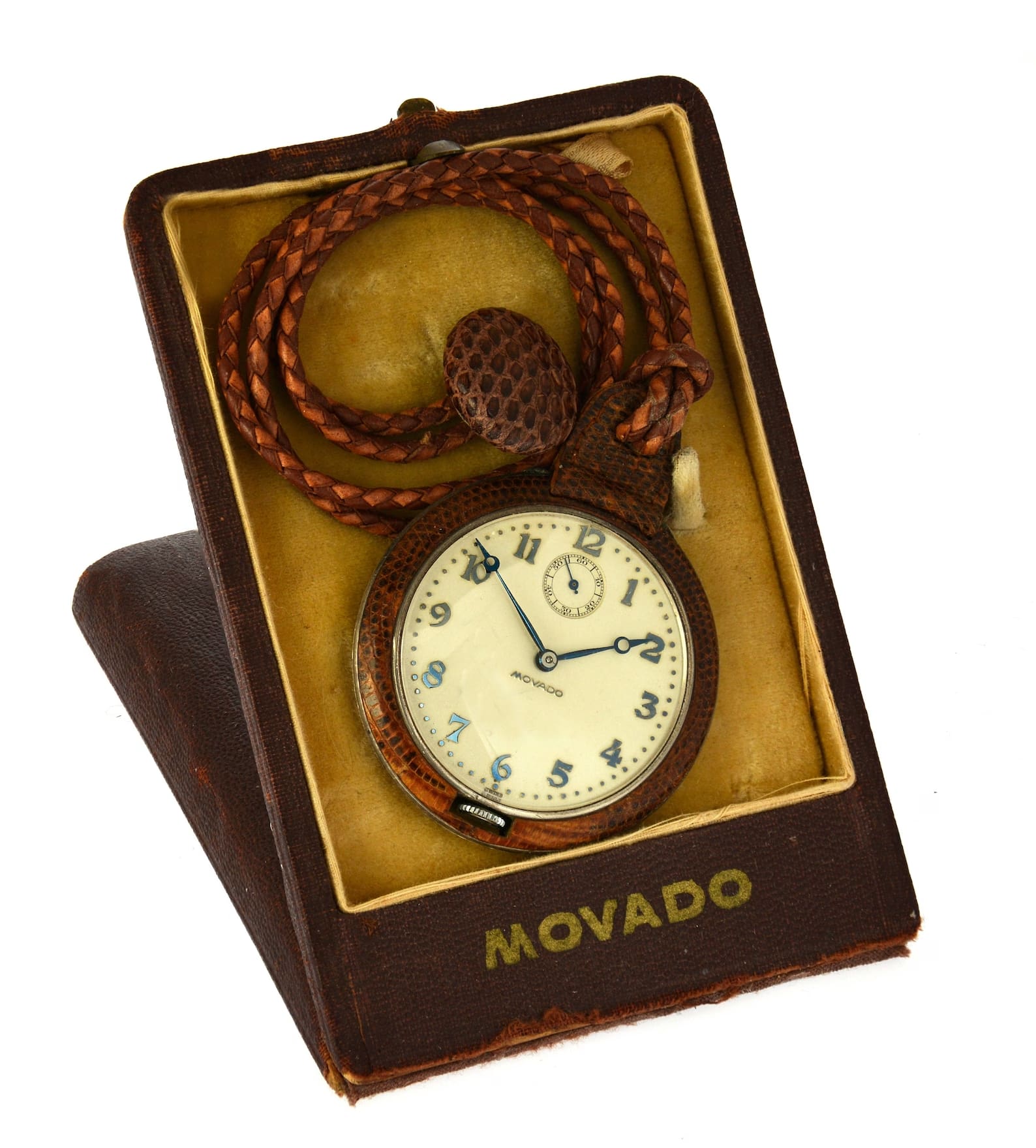
- Case: Haute Maroquinerie clad 0.935 silver
- Dial: Factory-original, signed Movado
- Seconds: Subsidiary seconds at 12 o’clock
- Movement: High-grade mechanical
- Jewels: Individually screw-fastened chatons
- Regulation: Geared precision regulator
- Finish: Côtes de Genève
- Diameter: 48 mm excluding pendant & chain
- Chain: Integral plaited buttonhole chain
- Condition: Excellent
Dial Signed: MOVADO, SWISS
Case Signed: Movado “Hand & Watch” trademark, BREVET, PATENT, MOVADO FACTORIES, SWISS
Hallmarks: 0.935 and Swiss official silver hallmark
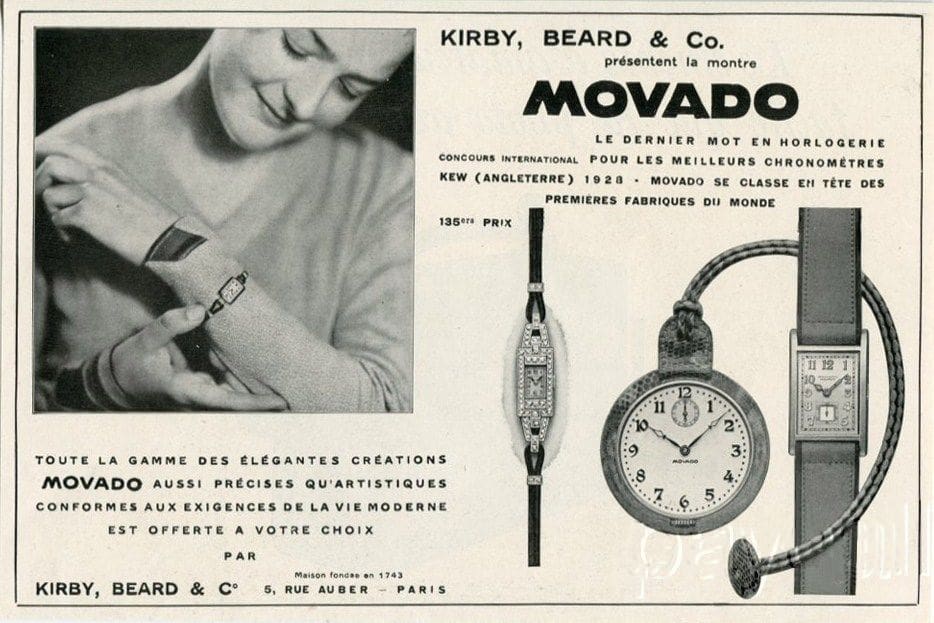
Offered for your consideration is this exceedingly rare and striking Movado pocket watch from the 1920s—an exceptional example of the company’s early pursuit of modern artistic design.
Already by the beginning of the twentieth century, Movado had become synonymous with technical excellence, precision and horological innovation, earning numerous observatory distinctions and important prizes at international exhibitions.
Increasingly, however, the company also began applying that same spirit of innovation to aesthetics, creating watches whose appearance reflected the emerging language of modern art and design.
The remarkable Art Deco watch offered here constitutes a prime example.
Its avant-garde combination of precious silver and haute maroquinerie leather was an exceptionally daring treatment for a precision watch of the period. Rather than treating the case merely as a protective container for the movement, Movado transformed the entire object into a sophisticated High-Fashion accessory.
Indeed, this watch represents an early expression of a design concept that Movado would subsequently carry forward into one of its most celebrated lines: the Ermeto, produced from the late 1920s through 1985 and similarly distinguished by the imaginative combination of fine watchmaking with luxurious external coverings.
Other important examples of Movado’s continuing aesthetic experimentation would include the curved Polyplan wristwatch, the Ermeto purse and travel watches, the minimalist Museum Watch and, many decades later, designs created in collaboration with artists including Andy Warhol.
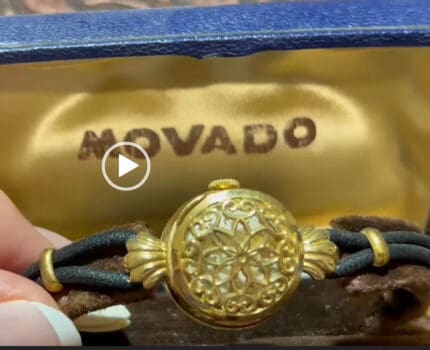
The circular 0.935 silver case is almost completely enrobed in finely worked haute maroquinerie leather, producing a striking contrast between precious metal, natural texture and the restrained geometry of the dial.
An integral plaited buttonhole chain continues the design and allows the watch to be worn in the traditional manner while becoming an important decorative element in its own right.
Particularly unusual is the placement of the subsidiary seconds register at the 12 o’clock position rather than the conventional 6 o’clock location. This gives the dial an immediately distinctive appearance while providing a particularly convenient visual reference for measuring elapsed seconds.
The result is a pocket watch that transcends conventional timekeeping and becomes an intentionally conceived Art Deco design object.
The aesthetic sophistication of the exterior is fully matched by the quality of the mechanical movement concealed within.
Its jewels are mounted in individually screw-fastened chatons, while the precision regulator incorporates a finely executed geared adjustment mechanism.
Particular attention was also devoted to finishing. The bridges are decorated with Côte de Genève, providing a visual expression of the care invested even in areas of the watch normally hidden from view.
For the collector, opening the case therefore reveals a second dimension to the watch: beneath its extraordinary High-Fashion exterior lies a beautifully executed work of traditional Swiss horology.
It is precisely this combination—avant-garde Art Deco design outside and serious Movado watchmaking within—that makes the present watch so compelling.
This exceedingly rare Movado Art Deco pocket watch remains in excellent vintage condition.
The original signed dial, 0.935 silver case, haute maroquinerie covering and integral plaited chain are beautifully preserved.
The important Movado case signatures and Swiss silver hallmarks remain clearly defined.
Movado was founded in La Chaux-de-Fonds, Switzerland, in 1881 by Achille Ditisheim. The name Movado derives from Esperanto and evokes the idea of being “always in motion.”
From the outset, Ditisheim and his small team of watchmakers concentrated upon precision manufacturing and fine mechanical watchmaking.
Their efforts soon achieved international recognition. By 1899, the company had received six first-class Official Rating Certificates from the Swiss Observatory, followed in 1900 by a Silver Medal at the Universal Exhibition in Paris.
During the following decade, Movado received further major distinctions at international exhibitions in Paris, Rome, Brussels and Rio de Janeiro.
Technical excellence was increasingly accompanied by adventurous design. One of the company’s most celebrated early achievements was the Polyplan, whose extraordinary curved movement and case represented a dramatic departure from conventional watch construction.
Movado continued this marriage of engineering and aesthetics with the Ermeto, an ingenious compact watch whose protective outer case became one of the company’s most recognizable creations and remained in production for decades.
In the post-war period, Movado became equally associated with minimalist modernism through the Museum Watch, conceived by American designer Nathan George Horwitt. Its radically uncluttered dial, marked principally by a single dot at 12 o’clock, became one of the most recognizable watch designs of the twentieth century.
Movado would later extend this artistic tradition through collaborations with leading artists and designers, including Andy Warhol.
Created during the flowering of Art Deco and predating the celebrated Ermeto line, the present 0.935 silver pocket watch already displays the combination of unconventional materials, refined mechanics and daring modern design that would become one of Movado’s defining characteristics. Its remarkable state of preservation and unusual haute maroquinerie treatment make it an especially desirable surviving example for the collector of important vintage watches and twentieth-century design.